My 7-year-old daughter was doing her homework, which consisted of writing sentences based on simple pictures. Sample: Next to a picture of a ball, she wrote "The ball rolled into the street." Her complaints about having to write these sentences often reach the pitch and tenor of an undergraduate penning a term paper the night before it's due.
But I digress. Next to a picture of a goat, she wrote: "Goats eat everything. No note, no goat."
This is a not-so-veiled reference to George Saunders' brilliant Pastoralia, a book she has not yet read. Although I have read it, and apparently, I am also fond of speaking of goats and notes.
No word yet on what her first grade teacher made of the quote.
Thursday, March 01, 2007


Napoleon's Pyramids
Here's the most recent of my book reviews for The Oregonian. I had never been a fan of historical thrillers, but this one was kind of a fun read.
A thrilling trip to beauty, mystery and fear
Sunday, February 18, 2007
MIRIAM WOLF
I f they had ever met, Philip Marlowe and Ethan Gage, the hero of William Dietrich's newest historical thriller "Napoleon's Pyramids," might have become fast friends. They're both clever and handy with firearms; they're morally complex; they're often caught up in situations they don't fully understand, situations that lead to them getting shot at, being beaten or waking up with snakes in their bedrooms. And they both appreciate a well-executed example of the female form.
The difference is that while Marlowe prowled Los Angeles in novels by Raymond Chandler, Gage accompanies Napoleon Bonaparte in his 1798 military campaign in Egypt. The general is hoping to conquer Egypt on the way to snatching India from British control. Gage is along as one of a team of "savants," scientists that accompany Bonaparte to help unlock the mysteries of the pyramids.
Gage's savant credentials are weak at best. An American, Gage was apprenticed to Benjamin Franklin, who taught him enough about electricity to perform a few parlor tricks. The real reason behind his recruitment is a medallion Gage won in a Paris poker game. Although the golden medallion with vaguely Egyptian markings seems innocuous enough, people seem to want it pretty badly, and dead bodies start piling up in Gage's wake.
Once in Egypt, Gage becomes allied with Astiza, a beautiful servant who is definitely more than she seems -- she speaks several languages, worships the goddess Isis and can kill a snake with aplomb. Meanwhile, Gage also proves himself to Napoleon, not as a savant, but through his battle skill with his preferred weapons -- long rifle and tomahawk.
Dietrich is great at bringing these historic battles to life. His description of the Battle of the Nile, in which England's Admiral Nelson destroyed Bonaparte's ships in the harbor near Alexandria, is particularly poignant, all smoke and chaos and fear. Dietrich also slyly shows some parallels between Napoleon's Middle East misadventure and a more modern one:
"When the Egyptians understand that we're here to liberate, not oppress, they'll join us in the fight against the Mamelukes," notes Bonaparte.
"Victory is sometimes more untidy than battle. An assault can be simplicity itself; administration an entangling nightmare."
Dietrich evokes the beauty and mystery of Egypt. He lets us wonder at the pyramids and other monuments that rose out of the desert, full of secrets and mysteries. And he doesn't neglect the thriller part of the historical thriller genre. We follow Gage as he faces down assassins, frees a band of slaves, sneaks through a sequestered harem at midnight, crawls through secret passageways in pyramids that no one has seen for millennia. And all the while, Gage wins us over with his American charm and gumption.
Dietrich discusses "Napoleon's Pyramids" 7 p.m. Sunday at Borders Bridgeport Village, 7227 S.W. Bridgeport Road, Tigard; and 7 p.m. Monday at Powell's Books at Cedar Hills Crossing, 3415 S.W. Cedar Hills Blvd., Beaverton.
Miriam Wolf recently reviewed "Sacred Games" by Vikram Chandra for The Oregonian.
A thrilling trip to beauty, mystery and fear
Sunday, February 18, 2007
MIRIAM WOLF
I f they had ever met, Philip Marlowe and Ethan Gage, the hero of William Dietrich's newest historical thriller "Napoleon's Pyramids," might have become fast friends. They're both clever and handy with firearms; they're morally complex; they're often caught up in situations they don't fully understand, situations that lead to them getting shot at, being beaten or waking up with snakes in their bedrooms. And they both appreciate a well-executed example of the female form.
The difference is that while Marlowe prowled Los Angeles in novels by Raymond Chandler, Gage accompanies Napoleon Bonaparte in his 1798 military campaign in Egypt. The general is hoping to conquer Egypt on the way to snatching India from British control. Gage is along as one of a team of "savants," scientists that accompany Bonaparte to help unlock the mysteries of the pyramids.
Gage's savant credentials are weak at best. An American, Gage was apprenticed to Benjamin Franklin, who taught him enough about electricity to perform a few parlor tricks. The real reason behind his recruitment is a medallion Gage won in a Paris poker game. Although the golden medallion with vaguely Egyptian markings seems innocuous enough, people seem to want it pretty badly, and dead bodies start piling up in Gage's wake.
Once in Egypt, Gage becomes allied with Astiza, a beautiful servant who is definitely more than she seems -- she speaks several languages, worships the goddess Isis and can kill a snake with aplomb. Meanwhile, Gage also proves himself to Napoleon, not as a savant, but through his battle skill with his preferred weapons -- long rifle and tomahawk.
Dietrich is great at bringing these historic battles to life. His description of the Battle of the Nile, in which England's Admiral Nelson destroyed Bonaparte's ships in the harbor near Alexandria, is particularly poignant, all smoke and chaos and fear. Dietrich also slyly shows some parallels between Napoleon's Middle East misadventure and a more modern one:
"When the Egyptians understand that we're here to liberate, not oppress, they'll join us in the fight against the Mamelukes," notes Bonaparte.
"Victory is sometimes more untidy than battle. An assault can be simplicity itself; administration an entangling nightmare."
Dietrich evokes the beauty and mystery of Egypt. He lets us wonder at the pyramids and other monuments that rose out of the desert, full of secrets and mysteries. And he doesn't neglect the thriller part of the historical thriller genre. We follow Gage as he faces down assassins, frees a band of slaves, sneaks through a sequestered harem at midnight, crawls through secret passageways in pyramids that no one has seen for millennia. And all the while, Gage wins us over with his American charm and gumption.
Dietrich discusses "Napoleon's Pyramids" 7 p.m. Sunday at Borders Bridgeport Village, 7227 S.W. Bridgeport Road, Tigard; and 7 p.m. Monday at Powell's Books at Cedar Hills Crossing, 3415 S.W. Cedar Hills Blvd., Beaverton.
Miriam Wolf recently reviewed "Sacred Games" by Vikram Chandra for The Oregonian.
Saturday, February 03, 2007
Sacred Games
Here's my Sacred Games review from the Oregonian
Story sweeps reader deep into gangland Mumbai
Sunday, January 28, 2007
By MIRIAM WOLF
Once in a while you find a book that sucks you so thoroughly into the world it creates that each time you slip your bookmark between the pages and close the cover, you come up blinking, surprised to find yourself in your own skin again.
Vikram Chandra's intricate "Sacred Games" is just such a novel.
Set in Mumbai, India, the book opens as famous gangland leader Ganesh Gaitonde commits suicide inside an impenetrable bunker. Sikh police inspector Sartaj Singh has been mysteriously summoned to the bunker and bears witness to Gaitonde's last words.
Instead of closing a chapter in Mumbai crime, Gaitonde's suicide sets in motion an increasingly desperate hunt for answers: Why would an extremely successful (not to mention handsome and respected) man take his own life? Who was the woman found dead in the bunker with him? How does Gaitonde's guru fit into the puzzle. In alternating chapters, Singh and Gaitonde tell their stories.
Through them, Chandra weaves a dense tale, filled with intersecting characters. Singh is a moral man who must immerse himself in the bribery and corruption that fuel the police department to get anything done. Like any noir hero worth his salt, he's world weary: "Time had visited him with its depredations, and worn him down, but he liked the feeling of being dilapidated. It was restful."
But unlike Philip Marlowe, Singh's crime-fighting tools include a form of meditation:
"He began to breathe deeply, in a rhythm he had developed in a thousand stakeouts. If he could get it just right, heat and sweat would recede, and time would turn inward on itself until it whirlpooled into stillness, and he was relieved of the world while he was still in it."
Gaitonde, meanwhile, is the very picture of an international criminal, consorting with movie stars and amassing fortunes, even when he's commanding his gang from inside prison. But a powerful spiritual guru comes into his life, asking nothing from Gaitonde but his devotion -- and some light gun-running duties.
With mounting horror, both characters begin to discover the true dimensions of the guru's plans: Singh discovers that the bunker in which Gaitonde ended his life is a bomb shelter, while men who Gaitonde send on a secret smuggling errand for his guru begin to die of radiation poisoning.
"Sacred Games" can be read and enjoyed as an edge-of-your-seat thriller. It has plenty of action, violence and blood -- and if you can't curse fluently in Hindi when you're done with it, then you weren't paying attention. But Chandra's sure-handed writing injects the novel with layers of depth and meaning; he captures history, politics, current events race, class and religion. He clearly loves Mumbai and evokes it in dazzling detail: You can smell the streets, taste the foods and hear the cacophony of the big, chaotic city on every page. And through his evocation of the Hindus, Sikhs, Muslims and Christians who interact with each other in this crowded nation, we see how old wounds and new hurts can spark into sudden violence.
In the 928 pages of "Sacred Games," Chandra has a lot of space to stretch out. He uses it to show how the strands of people bound together through family, loyalty or simple geography weave a web that is as interconnected as it is inescapable.
Chandra reads from "Sacred Games" at 7:30 p.m. Monday at Powell's City of Books, 1005 W. Burnside St.
Miriam Wolf is a Portland writer. She last reviewed "Ines of My Soul" by Isabel Allende for The Oregonian.
Story sweeps reader deep into gangland Mumbai
Sunday, January 28, 2007
By MIRIAM WOLF
Once in a while you find a book that sucks you so thoroughly into the world it creates that each time you slip your bookmark between the pages and close the cover, you come up blinking, surprised to find yourself in your own skin again.
Vikram Chandra's intricate "Sacred Games" is just such a novel.
Set in Mumbai, India, the book opens as famous gangland leader Ganesh Gaitonde commits suicide inside an impenetrable bunker. Sikh police inspector Sartaj Singh has been mysteriously summoned to the bunker and bears witness to Gaitonde's last words.
Instead of closing a chapter in Mumbai crime, Gaitonde's suicide sets in motion an increasingly desperate hunt for answers: Why would an extremely successful (not to mention handsome and respected) man take his own life? Who was the woman found dead in the bunker with him? How does Gaitonde's guru fit into the puzzle. In alternating chapters, Singh and Gaitonde tell their stories.
Through them, Chandra weaves a dense tale, filled with intersecting characters. Singh is a moral man who must immerse himself in the bribery and corruption that fuel the police department to get anything done. Like any noir hero worth his salt, he's world weary: "Time had visited him with its depredations, and worn him down, but he liked the feeling of being dilapidated. It was restful."
But unlike Philip Marlowe, Singh's crime-fighting tools include a form of meditation:
"He began to breathe deeply, in a rhythm he had developed in a thousand stakeouts. If he could get it just right, heat and sweat would recede, and time would turn inward on itself until it whirlpooled into stillness, and he was relieved of the world while he was still in it."
Gaitonde, meanwhile, is the very picture of an international criminal, consorting with movie stars and amassing fortunes, even when he's commanding his gang from inside prison. But a powerful spiritual guru comes into his life, asking nothing from Gaitonde but his devotion -- and some light gun-running duties.
With mounting horror, both characters begin to discover the true dimensions of the guru's plans: Singh discovers that the bunker in which Gaitonde ended his life is a bomb shelter, while men who Gaitonde send on a secret smuggling errand for his guru begin to die of radiation poisoning.
"Sacred Games" can be read and enjoyed as an edge-of-your-seat thriller. It has plenty of action, violence and blood -- and if you can't curse fluently in Hindi when you're done with it, then you weren't paying attention. But Chandra's sure-handed writing injects the novel with layers of depth and meaning; he captures history, politics, current events race, class and religion. He clearly loves Mumbai and evokes it in dazzling detail: You can smell the streets, taste the foods and hear the cacophony of the big, chaotic city on every page. And through his evocation of the Hindus, Sikhs, Muslims and Christians who interact with each other in this crowded nation, we see how old wounds and new hurts can spark into sudden violence.
In the 928 pages of "Sacred Games," Chandra has a lot of space to stretch out. He uses it to show how the strands of people bound together through family, loyalty or simple geography weave a web that is as interconnected as it is inescapable.
Chandra reads from "Sacred Games" at 7:30 p.m. Monday at Powell's City of Books, 1005 W. Burnside St.
Miriam Wolf is a Portland writer. She last reviewed "Ines of My Soul" by Isabel Allende for The Oregonian.
Sunday, November 26, 2006
Chile Today
Here's my latest book review from the Oregonian, printed Sunday, November 19.
Conquistadora conquers blood, sweat and Chile
Sunday, November 19, 2006
MIRIAM WOLF
L et the minimalist writers have their barren plots, their juiceless narratives. I'd rather read an Isabel Allende novel. Her books teem with richness, complexity and vivacity.
Her newest book, "Ines of My Soul," is a bold historical novel that is a great marriage of subject and style. For Allende, the novelist whose uncle was the Chilean president until he was overthrown in a violent coup, the story of Ines Suarez, a conquistadora and one of the original Spanish colonizers of Chile, must have seemed like a perfect fit. The women of Allende's novels are strong, sensual and self-reliant -- Ines Suarez is no different. Her passion, strength and absolute disdain for the fear of death have made her a legendary figure.
Ines was born in a small Spanish town. As a young woman she learns to cook, sew and dowse for water -- skills that will serve her well in the New World. She marries young, a passionate ne'er do well who departs for Peru to get his hands on some of the gold that has made its way back to Spain from the colonies. Ines, stifled by a rigid society, decides to follow him. She finds not her husband, who has already been killed because of a venal politician, but an awakening of her senses:
"In this New World the air is warm, propitious to the flowers, with their seductive fragrances, and the fruit, warm and fleshy, provoke lust . . . I questioned the principles that had guided me in Spain. My youth was passing me by, my life was being wasted. Who cared about my virtue?"
She also finds the great Pedro de Valdivia, the Spanish captain who thirsts for the kind of fame that requires founding a whole nation. Passionately in love, Ines and Pedro set south from Peru.
Allende excels at immersing her readers in the sights, sounds, smells and even flavors of an era; she brings to life the hardships of crossing a seemingly endless desert, the terror of confronting the fierce Chilean Indians, and the beauty of that strip of South American land. Allende is a voluptuously visceral novelist, and "Ines of My Soul" is filled with blood, guts, sex and sweat.
And there is plenty of blood, for you can't have conquest without a people to conquer. In "Ines of My Soul," Allende doesn't shy away from the atrocities the Spanish perpetrated in the name of their God and their king:
". . . They descended like demons on defenseless villages, chaining the men, raping and kidnapping the women, killing or leaving the children behind; after they stole all the food and domestic animals, they burned the huts and maize. They made the Indians carry more than was humanly possible. They even strapped newborn foals onto their backs. . . ."
But the Indians do fight back, and Allende chronicles the clashes that accompanied the birth of the city of Santiago, including a legendary battle in which the Spanish only prevailed because Ines ordered the decapitated heads of prisoners to be flung onto the battle to frighten the Chilean Indians.
She fought alongside men, then dressed their wounds. She fed her famous empanadas to the poor of her city every day. Her intuition and network of friends helped her uncover several plots against de Valdivia. She founded hospitals, churches, convents and sanctuaries. Ines Suarez was a woman of great power, and Isabel Allende has honored her with an equally powerful novel.
Miriam Wolf is a Portland journalist who writes about books and food.
Conquistadora conquers blood, sweat and Chile
Sunday, November 19, 2006
MIRIAM WOLF
L et the minimalist writers have their barren plots, their juiceless narratives. I'd rather read an Isabel Allende novel. Her books teem with richness, complexity and vivacity.
Her newest book, "Ines of My Soul," is a bold historical novel that is a great marriage of subject and style. For Allende, the novelist whose uncle was the Chilean president until he was overthrown in a violent coup, the story of Ines Suarez, a conquistadora and one of the original Spanish colonizers of Chile, must have seemed like a perfect fit. The women of Allende's novels are strong, sensual and self-reliant -- Ines Suarez is no different. Her passion, strength and absolute disdain for the fear of death have made her a legendary figure.
Ines was born in a small Spanish town. As a young woman she learns to cook, sew and dowse for water -- skills that will serve her well in the New World. She marries young, a passionate ne'er do well who departs for Peru to get his hands on some of the gold that has made its way back to Spain from the colonies. Ines, stifled by a rigid society, decides to follow him. She finds not her husband, who has already been killed because of a venal politician, but an awakening of her senses:
"In this New World the air is warm, propitious to the flowers, with their seductive fragrances, and the fruit, warm and fleshy, provoke lust . . . I questioned the principles that had guided me in Spain. My youth was passing me by, my life was being wasted. Who cared about my virtue?"
She also finds the great Pedro de Valdivia, the Spanish captain who thirsts for the kind of fame that requires founding a whole nation. Passionately in love, Ines and Pedro set south from Peru.
Allende excels at immersing her readers in the sights, sounds, smells and even flavors of an era; she brings to life the hardships of crossing a seemingly endless desert, the terror of confronting the fierce Chilean Indians, and the beauty of that strip of South American land. Allende is a voluptuously visceral novelist, and "Ines of My Soul" is filled with blood, guts, sex and sweat.
And there is plenty of blood, for you can't have conquest without a people to conquer. In "Ines of My Soul," Allende doesn't shy away from the atrocities the Spanish perpetrated in the name of their God and their king:
". . . They descended like demons on defenseless villages, chaining the men, raping and kidnapping the women, killing or leaving the children behind; after they stole all the food and domestic animals, they burned the huts and maize. They made the Indians carry more than was humanly possible. They even strapped newborn foals onto their backs. . . ."
But the Indians do fight back, and Allende chronicles the clashes that accompanied the birth of the city of Santiago, including a legendary battle in which the Spanish only prevailed because Ines ordered the decapitated heads of prisoners to be flung onto the battle to frighten the Chilean Indians.
She fought alongside men, then dressed their wounds. She fed her famous empanadas to the poor of her city every day. Her intuition and network of friends helped her uncover several plots against de Valdivia. She founded hospitals, churches, convents and sanctuaries. Ines Suarez was a woman of great power, and Isabel Allende has honored her with an equally powerful novel.
Miriam Wolf is a Portland journalist who writes about books and food.
Monday, October 30, 2006
Plastic Fantastic
My book review on Alex Kuczynski's Beauty Junkies ran yesterday in the Oregonian. It's a horrifying (the book, not the review) peek into the world of plastic surgery. Check it out. Or just stay here and read it:
Entering the strange cosmos of cosmetic surgery
Sunday, October 29, 2006
BY MIRIAM WOLF
W e've entered an age when moviegoers are likely to be more entertained by guessing which actor has had cosmetic surgery than by the actual plot of the film they are watching; an age when women in their 20s feel the need to get "prophylactic" shots of Botox to stop facial wrinkles before they ever start; and when a face lift or breast enhancement has gone from a slightly shameful secret to a proudly displayed accessory of a high-end lifestyle.
In "Beauty Junkies: Inside Our $15 Billion Obsession With Cosmetic Surgery," New York Times reporter Alex Kuczynski shines a metaphorical light that is bright enough to reveal the scars of those surgeries on individuals and our culture.
It's juicy reading. Kuczynski doesn't spare the details of procedure junkies like her friend Robert, who maintains relationships with several doctors so he can get shots of Botox (a weakened form of botulism toxin that paralyzes facial muscles) every eight weeks, instead of the six-month break between shots that doctors recommend. As the chapter on Botox closes, Robert's heading into his doctor's office to get shots in his palms, the soles of his feet and his underarms. Kuczynski notes, "His goal is to live a life without wrinkles or sweat."
Then there's the Hollywood housewife who, after liposuction, a tummy tuck, face lifts and breast enhancement, underwent genital cosmetic surgery because, " 'I've spent so much money for the rest of me to look like Dolly Parton,' she says, 'so why should that . . . look like Willie Nelson?' "
But "Beauty Junkies" is more than the sum of its horror-story parts. Kuczynski delves into many facets of plastic surgery, from its history as a way to make the grievously wounded or deformed look more human to the money issues that drive the industry today. She makes surreal hay from a visit to the American Board of Plastic Surgery's trade show, where she fondles silicone implants, attends the "Effective Marketing Techniques for Plastic Surgeons" seminar and checks out her pores on a high-tech diagnostic machine.
She also looks into the sociological reasons for our obsession. Going beyond the easy answers and cheap shots about women of a certain age, Kuczynski looks for deeper cultural markers. She implicates factors as disparate as the mainstreaming of pornographic images in advertising, the peripatetic nature of our society, even managed-care health insurance and, yes, the cult of youth and perfection.
Kuczynski is not just a plastic surgery critic; she's also been a client, and has her own story of addiction, escalation and remorse to tell (". . . was it wrong to pay my mortgage late so I could get some Botox?"). It adds even more layers of depth to this already meticulously researched and highly entertaining book. Give it to those you love before they go "under the knife."
Miriam Wolf is a Portland writer.
Entering the strange cosmos of cosmetic surgery
Sunday, October 29, 2006
BY MIRIAM WOLF
W e've entered an age when moviegoers are likely to be more entertained by guessing which actor has had cosmetic surgery than by the actual plot of the film they are watching; an age when women in their 20s feel the need to get "prophylactic" shots of Botox to stop facial wrinkles before they ever start; and when a face lift or breast enhancement has gone from a slightly shameful secret to a proudly displayed accessory of a high-end lifestyle.
In "Beauty Junkies: Inside Our $15 Billion Obsession With Cosmetic Surgery," New York Times reporter Alex Kuczynski shines a metaphorical light that is bright enough to reveal the scars of those surgeries on individuals and our culture.
It's juicy reading. Kuczynski doesn't spare the details of procedure junkies like her friend Robert, who maintains relationships with several doctors so he can get shots of Botox (a weakened form of botulism toxin that paralyzes facial muscles) every eight weeks, instead of the six-month break between shots that doctors recommend. As the chapter on Botox closes, Robert's heading into his doctor's office to get shots in his palms, the soles of his feet and his underarms. Kuczynski notes, "His goal is to live a life without wrinkles or sweat."
Then there's the Hollywood housewife who, after liposuction, a tummy tuck, face lifts and breast enhancement, underwent genital cosmetic surgery because, " 'I've spent so much money for the rest of me to look like Dolly Parton,' she says, 'so why should that . . . look like Willie Nelson?' "
But "Beauty Junkies" is more than the sum of its horror-story parts. Kuczynski delves into many facets of plastic surgery, from its history as a way to make the grievously wounded or deformed look more human to the money issues that drive the industry today. She makes surreal hay from a visit to the American Board of Plastic Surgery's trade show, where she fondles silicone implants, attends the "Effective Marketing Techniques for Plastic Surgeons" seminar and checks out her pores on a high-tech diagnostic machine.
She also looks into the sociological reasons for our obsession. Going beyond the easy answers and cheap shots about women of a certain age, Kuczynski looks for deeper cultural markers. She implicates factors as disparate as the mainstreaming of pornographic images in advertising, the peripatetic nature of our society, even managed-care health insurance and, yes, the cult of youth and perfection.
Kuczynski is not just a plastic surgery critic; she's also been a client, and has her own story of addiction, escalation and remorse to tell (". . . was it wrong to pay my mortgage late so I could get some Botox?"). It adds even more layers of depth to this already meticulously researched and highly entertaining book. Give it to those you love before they go "under the knife."
Miriam Wolf is a Portland writer.
Tuesday, October 17, 2006
We Like Her, We Really Like Her
"What are you doing on October 31st?" Seth asked while we loitered around the bookstore.
"Giving out candy while you take Sage trick or treating," I answered.
"You might change your plans," he said, noting that Amy Sedaris would be at the downtown Powells that evening.
Since I was just at that moment hungrily leafing through her new book I Like You: Hospitality Under the Influence, a lavishly illustrated twist on those 1950s how-to-entertain books. In it, Ms. Sedaris shares her secrets on how to throw unforgettable bashes. With notes on everything from applying the perfect kohl to your eyes for your Greek party to making felt-covered pencil cups with rude or obscene sayings on them, this book can give you a whole lifestyle makeover. And she even providesthe recipe for her famous cupcakes!
"Giving out candy while you take Sage trick or treating," I answered.
"You might change your plans," he said, noting that Amy Sedaris would be at the downtown Powells that evening.
Since I was just at that moment hungrily leafing through her new book I Like You: Hospitality Under the Influence, a lavishly illustrated twist on those 1950s how-to-entertain books. In it, Ms. Sedaris shares her secrets on how to throw unforgettable bashes. With notes on everything from applying the perfect kohl to your eyes for your Greek party to making felt-covered pencil cups with rude or obscene sayings on them, this book can give you a whole lifestyle makeover. And she even providesthe recipe for her famous cupcakes!
Friday, October 13, 2006
Friday the 13th
While Harry Potter creator J.K. Rowling has been content to birth six behemoth novels starring her little wizard, Lemony Snicket (aka Daniel Evan Handler, whose non-Lemony novel of San Francisco teens -- The Basic Eight was plenty dark and funny) has published more than double that amount -- today, Friday the 13th, sees the publication of The End, the (sniff) last in the series. I will always have a soft spot for Mr. Handler, as he at one time lived in my 'hood -- though we've both since moved. Long live the Richmond District!
After devouring that, young goths with no where else to turn might look into the new edition of Jane Eyre illustrated by the always creepy good and gothic Dame Darcy, whose zine Meatcake was always eagerly devoured when it came into the Factsheet Five office.
Monday, October 09, 2006
Running with Memoirs
What if your famous son wrote a memoir that painted you as a mom who was as neglectful as you were nutty? That happened to Margaret Robinson, whose son Chris grew up to change his name and write the bestselling memoir ... wait for it ... Running with Scissors.
NPR digs her up and posts a profile on All Things Considered.
There have been few mothers as monstrous as the one in his memoir Running with Scissors. In it, Robison is described as so cold and self-absorbed that she gives away her young son to her psychiatrist.
But it turns out that she is a quiet literary person who sounds much more rueful about about losing the closeness with her son (they used to write together and critique each other's work), than about how she was portrayed in print.
As James Frey's experiences have pointed up, the hotter the memoir, the more grains of salt the reader has to take it with.
Thursday, October 05, 2006
Subject and Artist
The coffee table crushers have started to arrive in advance of the holiday season. First out of the gate, Annie Leibovitz's mammoth tome A Photographer's Life: 1990-2005. While she's best known for her work with celebrities (I think the ultimate Leibovitz photo is not the John and Yoko one, but the Meryl Streep portrait on the cover of a Leibovitz collection from the 1980s.), this book also lets readers into her personal life a bit with portraits of her longtime companion, cultural critic Susan Sontag.
Tuesday, October 03, 2006
Fast Foodie Nation
Once food was a status symbol for only a few of the richest people willing to down challenging dishes like foie gras and caviar. Now everyone from yuppies to convicts is insisting on farm-fresh produce, free-range eggs, and authentic South Indian food. What the hell happened? We used to be so happy with our Kraft macaroni and cheese and our Swanson TV dinners. Now all our pasta has to be hand stretched or extruded through brass dies. Where is Sylvia Lovegren, the author of one of my favorite books about food fads Fashionable Food, which traces American food manias from the Jello salads of the 1930s to the duck breast pizzas of the 1980s. It even has recipes, for those brave enough to dip into the past for their next dinner party. Sadly, the book, originally published in the 1990s has no information on the current we-are-all-foodies-now-(but-don't-call-us-that) craze.
Luckily there is a new book that purports to tell us all we need to know. David Kamp's The United States of Arugula has just been published to tons of interest (including reviews last Sunday in the New York Times, SF Chronicle, and The Oregonian. For the most part, the book is concerned with the personalities that drove the movement forward -- Alice Waters, Julia Child, Craig Claiborne, and James Beard. There is lots of gossip. Sadly, no recipes, though, since dining out is a big focus of the book.
Kamp's touring now, so you can check him out. He's at Portland's Powells Books tonight.
Friday, September 29, 2006
The People that You Meet at Starbucks
I like to think I'm more upper-middlebrow than lower-middle brow -- maybe that's the reason I disdain Mitch Albom. I was forced to read Tuesdays with Morrie for a book club I foolishly joined (I barely have enough opinions to sustain my freelance book reviewing -- I can't go spending them in a book club situation, and besides, the only thing I had in common with the other women in the club, all of whom were really nice and smart, was that we were all nursing newborns). That book had more pap than a visit to the gynecologist.
Maybe I'm just cynical. Ten million people can't be wrong, right? At any rate, Albom is about to be Starbucked, as his new heartwarmer For One More Day becomes the first author in the new Starbucks book program. The book, s slightly creepy novel about what would happen if you had one more day to spend with a loved one who died, treads familiar Albom territory of emotions, death, and healing.
Starbucks has done amazingly well in its music partnerships. The CDs sell like hotcakes. Not so much with its movie deal to promote Akeelah and the Bee. (People may be getting tired of the spelling bee thing, what with documentaries, broadway shows, novels, and other media flooding the market) Still, Albom doesn't really need Starbucks to push him, and the people who feel he's too populist and treacly probably are eschewing venti carmel macchiatos and strawberries and cream frappucinos in favor of espresso shots and mugs of shade grown in their locally owned cafe that features freshly roasted beans and housemade pastries.
Maybe I'm just cynical. Ten million people can't be wrong, right? At any rate, Albom is about to be Starbucked, as his new heartwarmer For One More Day becomes the first author in the new Starbucks book program. The book, s slightly creepy novel about what would happen if you had one more day to spend with a loved one who died, treads familiar Albom territory of emotions, death, and healing.
Starbucks has done amazingly well in its music partnerships. The CDs sell like hotcakes. Not so much with its movie deal to promote Akeelah and the Bee. (People may be getting tired of the spelling bee thing, what with documentaries, broadway shows, novels, and other media flooding the market) Still, Albom doesn't really need Starbucks to push him, and the people who feel he's too populist and treacly probably are eschewing venti carmel macchiatos and strawberries and cream frappucinos in favor of espresso shots and mugs of shade grown in their locally owned cafe that features freshly roasted beans and housemade pastries.
Thursday, September 28, 2006
Wes Anderson loved pop-up books

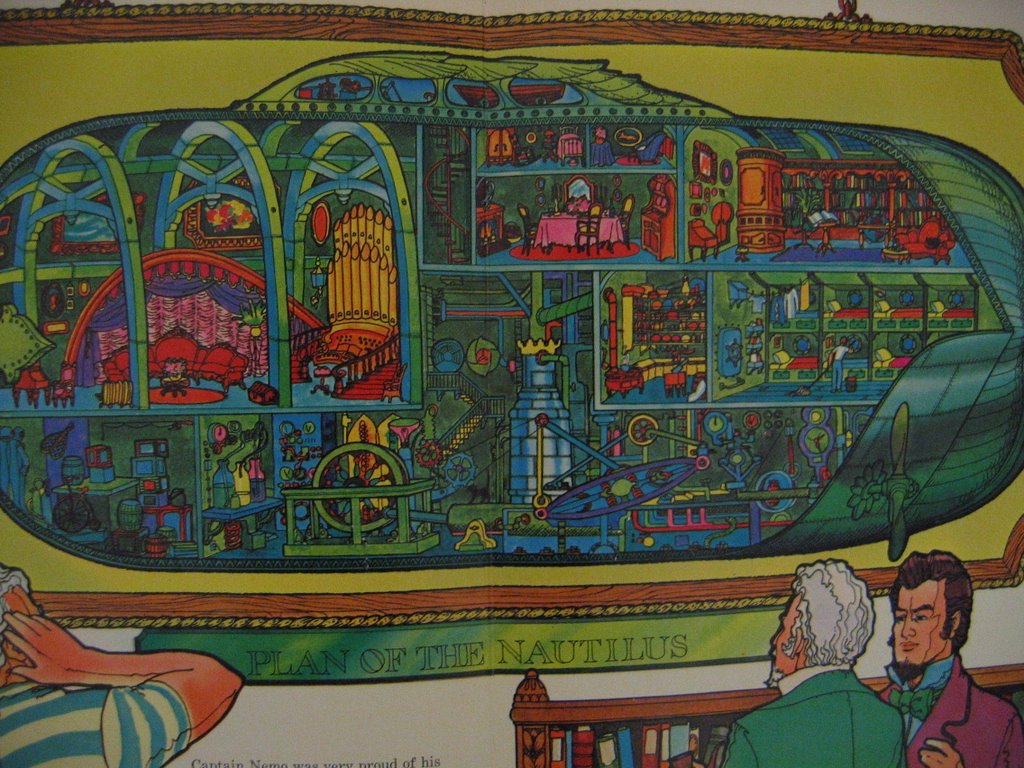
Wes Anderson has obviously been inspired by book on ocean adventure as shown by the significant role that Jaques Cousteau's book Diving for Sunken Treasure played in his filmRushmore. I love that movie so much that many times I've been tempted to pick up a hard back copy of the book. I was reading my copy of the pop-up version of 20,000 Leagues Under the Sea and came across this illustration and was immediately reminded of the scene in Life Aquatic where we are given a tour of his boat. I'm sure Wes and his brother Eric had this book when they were kids.
Too Much Television
I love projects in which someone immerses themselves in TV for days on end to prove what a shallow medium it is. In the 1990s, environmental critic Bill McKibben wrote The Age of Missing Information in which he recorded all the television available to him on cable and broadcast in a 24 hour period, then watched all 1700 hours of it. He then went into the woods to go camping for 24 hours. Which experience would teach him more -- a day in the woods or 1700 hours of TV? Hint: Camping.
In the latest issue of the The New Yorker, Bill Buford sets himself a comparatively light schedule of watching a mere 72 hours straight of the Food Network. Woozy with overstimulation, he becomes entranced with the visual pleasure of making a salad. Also, he caps on Rachael Ray.
In the latest issue of the The New Yorker, Bill Buford sets himself a comparatively light schedule of watching a mere 72 hours straight of the Food Network. Woozy with overstimulation, he becomes entranced with the visual pleasure of making a salad. Also, he caps on Rachael Ray.
Wednesday, September 27, 2006
My, What Big Thoughts You Have ....
The British Guardian Unlimited has a nice piece on the many and varied interpretations of the fairy tale "Little Red Riding Hood" to commemorate the opening of the kids' movie Hoodwinked on that side of the pond. Originally penned in 1697, the story has offered rich material for writers, filmmakers, graduate thesis penners, and other thinkers. Does her red cape represent menstruation? Sin? Is the wolf, well, a wolf? Or merely misunderstood? And what to make of the fact that my 1970s-era CB handle when I was a kid was "Red Riding Hood?"
There's lots to think about in this article, but perhaps its raison d'etre is this line, about the 1980s Neil Jordan film The Company of Wolves:
"A movie so Freudian that you keep expecting it to grow a beard and move to Vienna..."
Barnes & Noble stock jump on analysist upgrade
Barnes & Noble stock jumped when Goldman Sachs upgraded to "neutral" and removed the bookseller from its Americas Sell List. That reminds me of the gag on Arrested Development when their company's stock goes from "triple sell" to "Don't Buy" and everyone cheers.
Nevertheless, this is mostly good news for the book industry as one of the reasons cited for the upgrade is the slew of new blockbuster books planned for release this Fall.
Nevertheless, this is mostly good news for the book industry as one of the reasons cited for the upgrade is the slew of new blockbuster books planned for release this Fall.
Tuesday, September 26, 2006
History for Dummies
The [Blank] for Dummies series is 15 years old now, and the New York Times celebrated this past Sunday with a juicyish insider's piece on the series.
Starting with the DOS for Dummies book in 1991 (which surprisingly has no value today, if the prices on Ebay are any indication), IDG has more than 1000 For Dummies titles. That's a lot of stupidity, from Opera for Dummies to Diabetes for Dummies. Best of all? They call the process of editing the book to their style "dummifying" it.
Starting with the DOS for Dummies book in 1991 (which surprisingly has no value today, if the prices on Ebay are any indication), IDG has more than 1000 For Dummies titles. That's a lot of stupidity, from Opera for Dummies to Diabetes for Dummies. Best of all? They call the process of editing the book to their style "dummifying" it.


Pictures of Sony's eBook Reader

There's some cool pictures of Sony's new ebook reader over at Gizmodo. I'm amazed at how thin it is. Combine it with something like the Million Books Project and you have something very interesting.
Monday, September 25, 2006
Gone to New York, by Ian Frazier

Just finished Ian Fraizier's Gone to New York
 . Great book. I got the first edition hard back cuz I'm such a book geek but I just love the cover to the paperback version. It is instantly recognizable to any reader of the New Yorker as his bag snatcher story.
 I love books with lots of different stuff in it, particularly books that feature stuff from the New Yorker or other magazines. Books from Steve Martin and David Rakoff come to mind. What I love most about this book is how it holds together so well. It builds up short bits (from his Talk of the Town column) and other things into a large narrative about his life growing up in Ohio, moving to New York city, then to Brooklyn, and finally moving to Montclair, New Jersey.
His mind seems to work very much like my own, becoming obsessed with historical details and the unexplored underbelly of all the places he lives. His stories of living in a loft above an Army surplus store on Canal Street is like shooting fish in a barrel, but who would have though that New Jersey could be so interesting.
As someone who was born in Queens and lived many years in lower Manhattan, this book really satisfies a craving I'd had recently. As some might suggest it doesn't make me long to visit any time soon. In many ways it makes me even happier to be living in Portland right now.
While Ian Frazier is able to bring a rare sense of sanity to New York, Portland is the kind of place where it isn't a struggle to find the sanity. It's right there where you live, surrounded by your friends and community. It's when you leave Portland that you discover the insanity, which only makes life here even more satisfying.
Don't Let Me Buy Any More Books (At Least Not This Week)
What do you do if you're faced with an enormous tableful of (outdated but still pretty cool) children's hardback ex-library books? And what would you do if you had a child who loves books? And they were charging only a quarter for them?
Yes, you'd dive right in. Even though your daughter's shelves are bursting with books and the basement is overflowing with them and there's a stack of not-ex-library books that need to be read and returned so you can check out more.
This Saturday, the Twi-Night Rummage Sale at the Eagles featured just such a table. The woman who runs the sale rescued the books just as the school system was getting ready to throw them in the trash. I chose 16 books -- 14 for my kid and two for resale. They included such gems as About the B'nai Bagels by E.L. From the Mixed-up Files of Mrs. Basil E. Frankweiler Konigsburg and a photo-illustrated book on owning and caring for horses by Jill Krementz, A Very Young Rider, and a Robert McClung books on salmon. When I was a kid, I loved his Luna: The Story of a Moth.
Yes, you'd dive right in. Even though your daughter's shelves are bursting with books and the basement is overflowing with them and there's a stack of not-ex-library books that need to be read and returned so you can check out more.
This Saturday, the Twi-Night Rummage Sale at the Eagles featured just such a table. The woman who runs the sale rescued the books just as the school system was getting ready to throw them in the trash. I chose 16 books -- 14 for my kid and two for resale. They included such gems as About the B'nai Bagels by E.L. From the Mixed-up Files of Mrs. Basil E. Frankweiler Konigsburg and a photo-illustrated book on owning and caring for horses by Jill Krementz, A Very Young Rider, and a Robert McClung books on salmon. When I was a kid, I loved his Luna: The Story of a Moth.
Subscribe to:
Posts (Atom)